The Trade Digitalization Index (TDI) aims to provide a measure of progress in the digitalization of trade procedures and processes, with emphasis on achieving full cross-border paperless trade. The TDI 2025/2026 covers more than 170 economies and expands upon the first TDI launched in 2024, with increased emphasis on legal and sustainability aspects based on data from the latest UN Global Survey on Digital and Sustainable Trade Facilitation. The launch event covered presentation of the results followed by a panel discussion to highlight emerging good practices and lessons learned to accelerate progress towards sustainable trade digitalization.
About
The Trade Digitalization Index (TDI) is a joint initiative of five United Nations Regional Commissions (UNRCs), including ECA, ECE, ECLAC, ESCAP and ESCWA. The TDI underscores the significance of trade digitalization in enhancing and streamlining trade procedures, offering multiple benefits such as lowering compliance costs, facilitating faster movement of goods, and fostering opportunities for SMEs in cross-border trade.
In this context, the Trade Digitalization Index (TDI) is a novel measure assessing global progress in digitalizing trade procedures, based on data from the UN Global Survey on Digital and Sustainable Trade Facilitation. It offers governments a means to assess their progress, pinpoint weaknesses, and facilitate international organizations in identifying areas requiring additional support.
Highlight 2025/26: Global average TDI+ implementation stands at 55%, indicating much room for progress.
Note: Black values show regional averages with “don’t know” responses treated as no implementation (DK=0), following the standard methodology of the UNTF Survey. For reference, grey values show averages when “don’t know” responses are excluded (DK=missing).
Highlight 2025/26: Significant disparities exist in the implementation of different trade digitalization measures across regions, with the largest gaps persisting in cross-border operational exchange and sustainable trade digitalization.
Highlight 2025/26: Digitalization rates rose in all regions studied between 2023/24 and 2025/26 with an increase of 5 percentage points during this period for the common countries participating in both surveys.
Highlight 2025/26: The 19 individual trade digitalization measures included in TDI are found to have a statistically significant positive effect on trade, with substantial variation among them.
Measure Subgroup and Name
Estimated % increase in trade associated with a 1% increase in implementation of the Measure
Paperless Trade
E-Submission of Customs declarations
0.4088
E-Submission of Air Cargo Manifests
0.0473
E-Payment of Customs duties
0.0467
E-Single Window System
0.0467
E-Submission and issuance of import/export permits
0.0459
Automated Customs System
0.0455
E-Application/issuance of Preferential Certificates of Origin
0.037
Internet access for Customs and border agencies
0.0336
E-Application for Customs refunds
0.0313
E-Application/issuance of SPS certificates
0.016
Legal and Trust Framework
Laws and regulations for electronic transactions
0.0403
Legal framework for digital authentication
0.0376
Trade Digitalization Agreements and Mutual Recognition
0.013
Cross-Border Operational Exchange
Electronic exchange of Customs Declaration
0.0454
Electronic exchange of Certificate of Origin
0.0367
Paperless collection of payment from letters of credit
0.0312
Electronic exchange of Sanitary & Phyto-Sanitary Certificate
0.0249
Sustainable Trade Digitalization
Single Window facilitates traders access to finance
Highlight 2023/24: Substantial variations exist in trade digitalization rates between regions emphasizing the necessity for targeted strategies tailored to the unique needs of specific regions and economies.
Highlight 2023/24: Countries with special needs (LLDCs, LDCs, SIDS) share similar average trade digitalization rates, below the global average of 59%, placing these countries at a disadvantage in digitalization efforts and integration for cross-border trade.
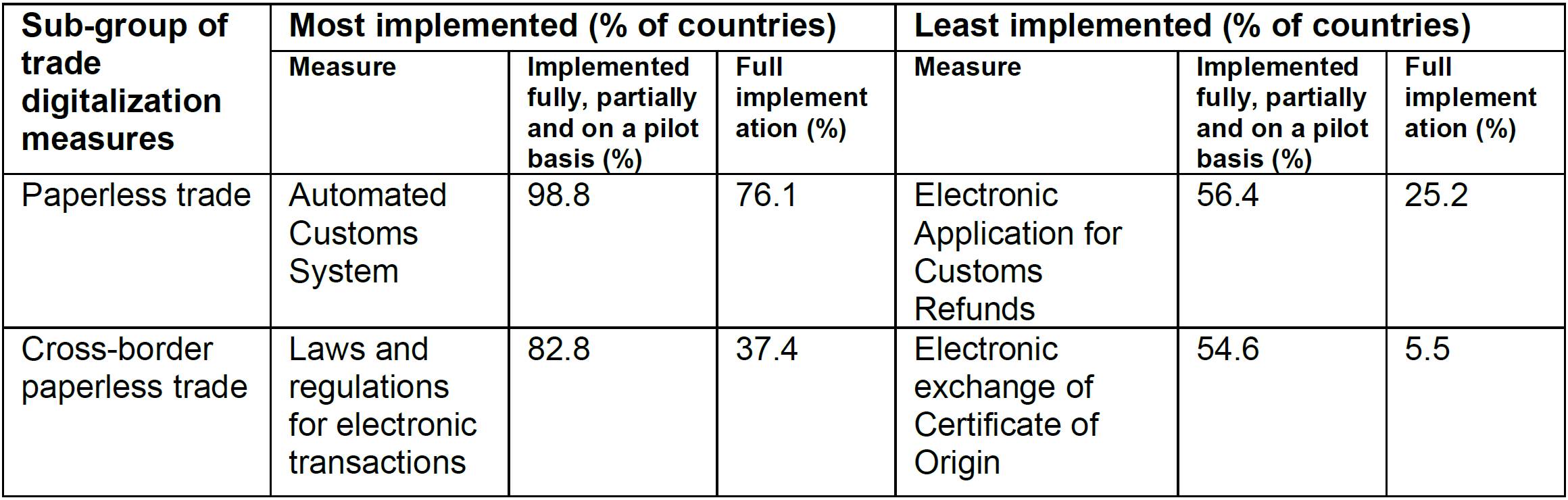
Highlight 2023/24: Significant disparities exist between the most and least implemented trade digitalization measures, and challenges persist in fully implementing cross-border paperless trade measures.
Highlight 2023/24: Global digitalization rates are on the rise il all regions studied between 2021-2023 with an encouraging increase of 8 percentage points during this period for the common countries participating in both surveys.